Serbia’s Reform Agenda: Five of Eight Milestones Achieved in the Business Environment Area
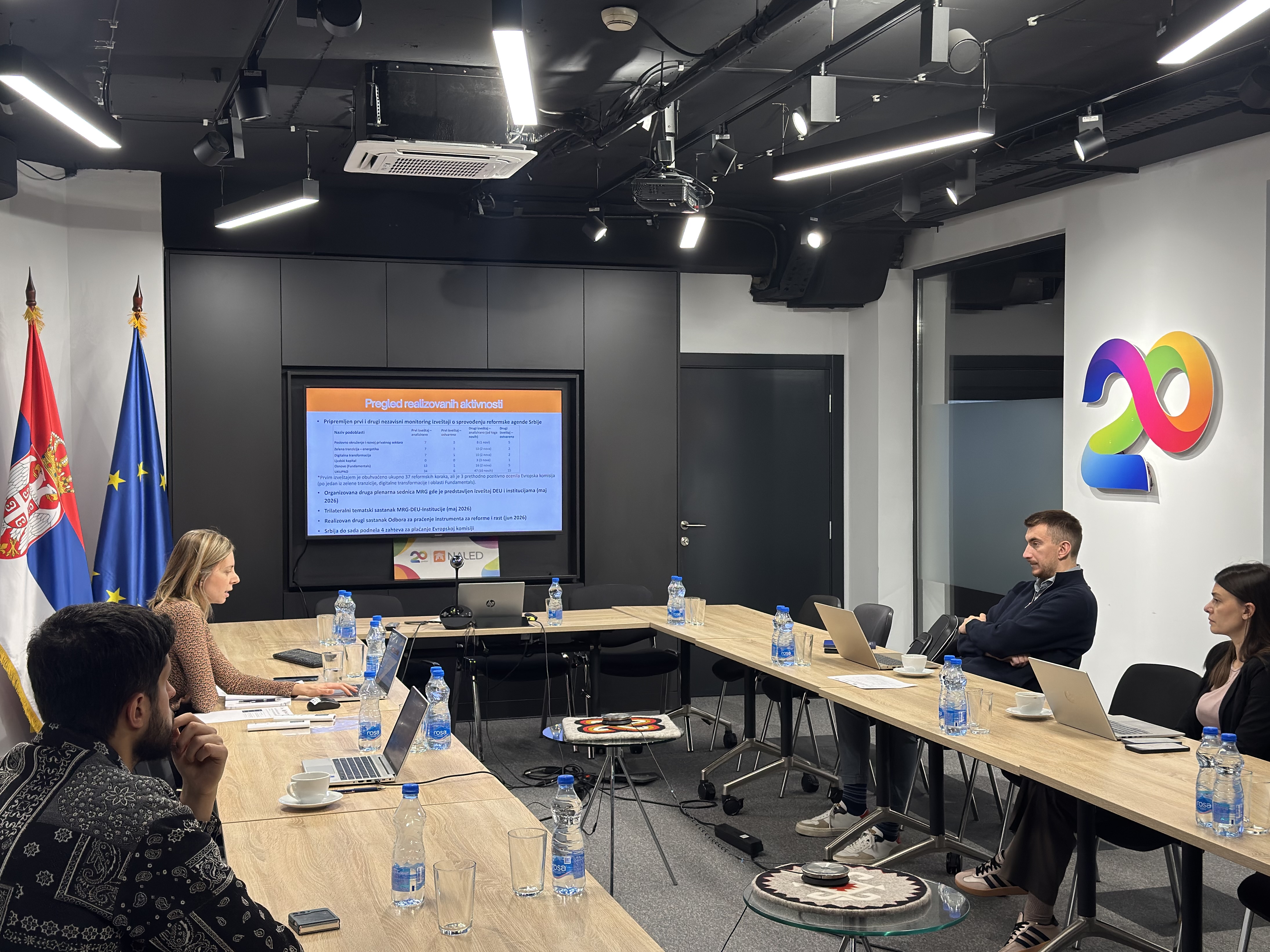
Serbia has fulfilled five of the eight Reform Agenda commitments monitored by civil society in the area of the business environment, while three milestones remain unfulfilled. The deadlines for a further seven of the 26 milestones in the entire area are due to expire by the end of the year. These were the conclusions reached by representatives of the Subgroup on the Business Environment and Private Sector Development at its second meeting, held in a hybrid format.
The Subgroup operates within the Cross-Sectoral Working Group for Monitoring the Implementation of the Reform Agenda, established by the National Convention on the European Union (NCEU), with the European Policy Centre (CEP) leading its work. The Republic of Serbia’s Reform Agenda for the 2024–2027 period is a key document for implementing reforms under the European Union’s Reform and Growth Facility for the Western Balkans, which makes financial support to Serbia conditional on the fulfilment of defined reform steps.
The Cross-Sectoral Working Group brings together civil society organisations, business associations and independent experts. Through independent reports and recommendations, it contributes to transparency and accountability in the implementation of reforms, as well as dialogue with Serbian institutions and the European Union.
In its second independent report, covering reform milestones monitored as of 30 June 2026, the Cross-Sectoral Working Group confirmed that previously achieved results had been sustained in the financing of researchers and innovative companies, alignment with the European Research Infrastructure Consortium Regulation, and the financing of rural infrastructure projects.
Progress was also made in the area of state aid following the Government’s adoption, in June, of the State Aid Inventory for 2017–2026 and the Action Plan for Aligning State Aid Schemes. However, Serbia has yet to fulfil its obligations concerning the publication of contracts concluded under interstate agreements, amendments to the Government’s Rules of Procedure regarding public consultations, and the adoption of the Law on Land Consolidation.
Participants highlighted the limited availability of information and data needed to independently verify progress in implementing reforms, particularly in relation to rural infrastructure projects and reform milestones concerning state-owned enterprises. The Subgroup will therefore request additional information from the competent institutions. They also raised questions about how the grace period, or additional time allowed to fulfil reform milestones that were not completed within the prescribed deadlines, is calculated, as well as the possibility of assessing quantitative milestones as partially fulfilled. The Working Group has requested clarification from the European Commission on these matters.
The Subgroup also reviewed seven reform milestones due by December 2026. These concern improvements to public investment management, requirements for appointing governing bodies and establishing internal audit functions in state-owned enterprises, changes to the legal form of public enterprises, increasing the private sector’s share of expenditure on research and innovation, financing rural infrastructure projects, and professional supervision in land consolidation procedures.
The Cross-Sectoral Working Group will finalise its second report after reviewing comments from the EU Delegation and the competent institutions and present it at a plenary session in November. The EU Delegation, Serbian institutions and the National Convention on the European Union are also expected to hold a trilateral meeting by the end of the year.
The key message of the meeting was that the success of reforms is measured not only by the adoption of regulations and strategic documents, but also by their consistent implementation and tangible results. Transparency and data availability are therefore essential for independently verifying progress, particularly given that the disbursement of EU financial support to Serbia also depends on the fulfilment of reform milestones.
The Subgroup on the Business Environment and Private Sector Development will continue to independently monitor the implementation of the Reform Agenda, focusing in particular on milestones due by the end of 2026, as well as those that have not been completed within the prescribed deadlines.