New EU Sustainability Rules Pose a Challenge for 8,000 Companies in the Wood Industry
Nearly 8,000 companies in the wood industry and related sectors, employing around 45,000 people, will need to adapt their operations to new EU sustainability and circularity requirements in order to remain competitive in the European market. Although 72% of companies in the sector are export-oriented and more than 60% sell their products to the European Union, awareness of the new requirements remains very low, according to a new NALED study.
According to the Sustainability Analysis of the Wood Supply Chain in Line with ESG Standards, conducted within the project “More Efficient Public Procurement and Sustainable Supply Chains for Greater Competitiveness”, implemented by NALED with the support of the Government of Sweden, only 18% of businesses are familiar with sustainability principles, and an even smaller share actively applies them in their operations. Furthermore, 89% of companies are unfamiliar with relevant EU regulations, while most business representatives are unaware that these regulations even exist, even when specific legislation is mentioned.
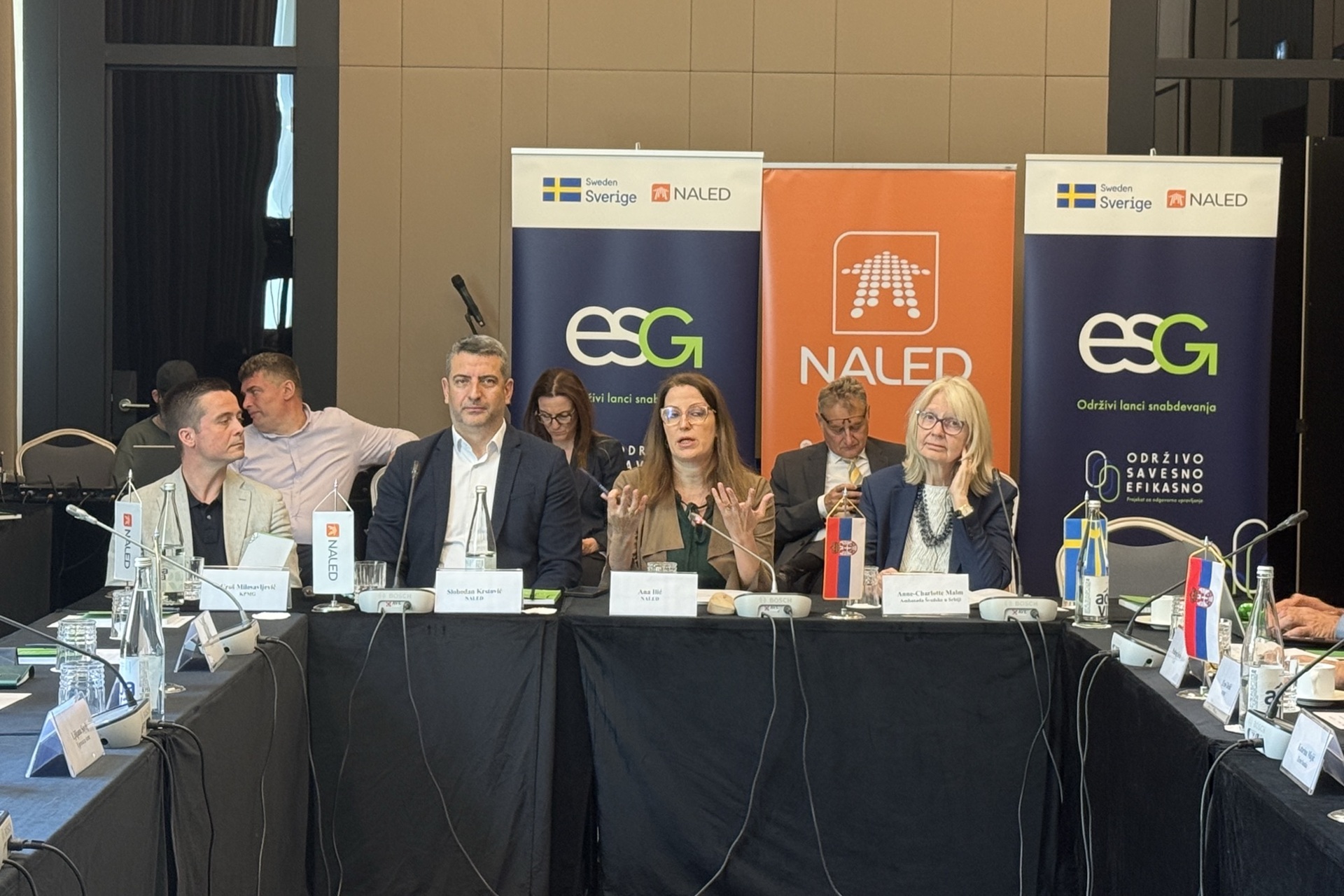
“Wood processing is one of the sectors that can become a significant driver of Serbia’s economic development, but only if we recognize in time the changes coming from the European market. In addition to the origin of raw materials, one of the key aspects of supply chain sustainability is the use of alternative raw materials and recycled inputs. Of the companies surveyed, only 13% use recycled materials in production, while as many as 62% have received inquiries from customers or business partners regarding the origin of their materials. Although several EU regulations directly affect domestic businesses, it is evident that companies lack the capacity to fully understand and implement these requirements,” said Uroš Milosavljević, Partner at KPMG and member of NALED’s Supervisory Board.
A particular challenge is posed by the EU Regulation on Deforestation-Free Products (EUDR). The regulation could have a significant impact on companies operating in the wood industry and exporting to the European market. It is therefore necessary to determine which institution will be responsible for this issue, how support will be provided to businesses, and whether Serbia should consider developing its own mechanism for verifying the origin of raw materials.
One of the first steps should be strengthening companies’ capacities for sustainability reporting. Serbia is currently in the process of amending its Accounting Law, but there is a risk that the direct reporting obligation will apply to only a limited number of companies. According to estimates, if the European directive is transposed only formally, approximately 20% of companies could fall under the reporting obligation, while in practice the number could be even lower, potentially in the single digits.
For this reason, one of the key recommendations of the Analysis is the establishment of a clear framework that would help companies, banks, investors, and institutions understand what constitutes sustainable business practices and provide guidance on the development of green business models.
Furthermore, to encourage the long-term development of sustainable practices and improve business competitiveness, it is essential to understand what is being imported, under which rules, and how the origin of raw materials is verified. This requires the development of an integrated digital solution for product traceability throughout the entire value chain, particularly in light of upcoming European requirements related to the Digital Product Passport and data management.
Green public procurement, eco-design, and ecolabels have also been identified as important instruments for developing a sustainable market. Although Serbia has introduced a voluntary ecolabel scheme, it is necessary to establish incentive mechanisms that would increase demand for sustainable materials and products. Without such incentives, companies lack confidence that investments in sustainable production will be recognized and rewarded by the market.
The Analysis also concludes that the new Circular Economy Development Programme must move beyond a strategic framework and be translated into concrete implementation measures and sustainable business models within the wood industry. This will require more ambitious circularity targets, considering that only 1% of materials in Serbia currently return to circular flows, compared to around 10% in the European Union. At the same time, 80% of waste ends up in landfills, compared to approximately 20% in the EU.
Photo source: Shutterstock